
Voluntary Purchase Life Annuity
Blending is not only for retirement money
A voluntary purchase life annuity can change the role discretionary capital plays in retirement.
Many retirees use discretionary savings held in a flexible investment plan to supplement their monthly income. This may appear to be a straightforward and tax-efficient approach, but it asks one portfolio to achieve two different objectives:
-
to provide a steady income for an unknown period, and
-
to remain invested for future growth.
When the withdrawal rate is the only lever available, the client faces a difficult trade-off: draw too much and the capital may be depleted, draw too little and they may have to compromise their current lifestyle.
A voluntary purchase life annuity introduces another way to structure the income. It converts part of the client’s discretionary capital into an income payable for life, regardless of how long the client lives or what happens in investment markets. The remaining capital can stay invested, but it no longer needs to support the full income requirement on its own.
A practical illustration
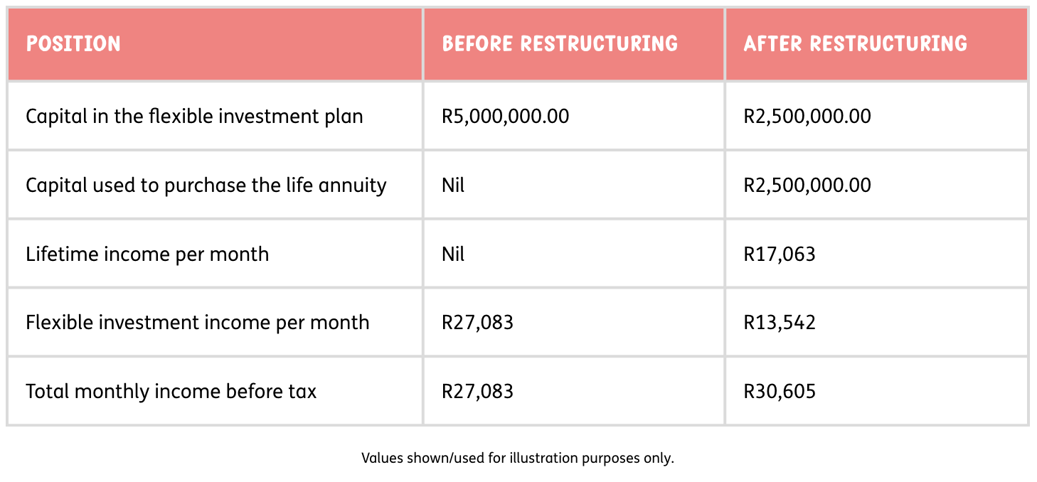
Consider a 70-year-old man with R5 million in a flexible unit trust investment plan. He is drawing 6.5% a year, giving him R27,083 a month before tax.
Now consider splitting the capital equally:
- R2.5 million is used to purchase a single-life with-profit annuity with a ten-year minimum payment period.
- R2.5 million remains invested in the flexible investment plan.
In this illustration, the life annuity provides R17,063 a month, while a 6.5% drawdown from the remaining flexible investment produces R13,542 a month. Together, these amounts increase the total illustrated monthly income to R30,605 before tax. A little over half of that income is now payable for life.
The client does not have to take the full uplift
The additional income created by the new structure does not necessarily have to be spent - it can be used to reduce the withdrawal rate on the flexible investment plan, or the benefit can be divided between more income today and greater protection for the remaining capital.
In the underlying illustration, the client has three broad choices:
- Take the uplift as income: Maintain a 6.5% withdrawal from the invested portion, increasing total monthly income to R30,605.
- Balance income and sustainability: Reduce the withdrawal rate to 6%, providing total monthly income of R29,563.
- Maintain the original income: Reduce the withdrawal rate on the invested portion to 4.81%, keeping total monthly income at R27,083.
The third option is particularly useful for illustrating the planning opportunity. The client maintains the same income as before, but secures a portion and reduces the withdrawal rate required from the remaining flexible investment.
The tax treatment is also different
Income from a voluntary purchase annuity falls under section 10A of the Income Tax Act. The capital element of the purchased annuity is exempt from normal tax, while only the interest element is taxable. The exempt proportion is determined when the annuity is purchased based on to the purchase price and expected term.
In this illustration, the R17,063 monthly annuity payment includes a tax-free capital element of R15,678 and a taxable portion of R1,385. Estimated PAYE is shown as nil when other income is ignored. The client’s actual position will, of course, depend on their complete income and tax circumstances.
The flexible investment plan has a different tax profile, because the amount withdrawn is not itself taxed as income. Instead, tax may arise from interest distributions, dividends and capital gains when units are sold.
Every withdrawal from a unit trust involves the disposal of units. As the portfolio grows and the difference between the units’ base cost and market value increases, a greater portion of later withdrawals may represent a capital gain. The annual exclusion may therefore absorb less of the gain over time.
By allocating part of the portfolio to a life annuity, the client reduces the size of the flexible investment and the value of units that must be sold to provide monthly income. Depending on the client’s circumstances, this may help them remain within the available interest exemption and annual capital-gains exclusion for longer.
A broader way to think about blending
Blending is often discussed in relation to compulsory retirement money, but the same principal that underlies blending can be applied more broadly.
Different assets can be given different jobs: one portion can provide an income payable for life, while another remains invested for flexibility, growth and access to capital.
For advisers, the question is therefore not simply whether discretionary capital should remain invested or be annuitized. The more useful question is:
What combination gives the client the income they need today, while improving the resilience of their plan for an uncertain lifetime?
A well-considered blend may allow an adviser to increase the client’s income, reduce the pressure on invested capital or achieve a measured combination of both.

Important information
This article is for adviser information only and does not constitute financial, tax or legal advice. The figures are illustrative and are based on the assumptions described. Actual annuity rates, investment returns, tax consequences and client outcomes will differ. Financial advisers should consider each client’s complete financial position, objectives and circumstances, and obtain specialist tax advice where appropriate.
About the author
Clive Lazar
Business Development Manager
Prior to joining Just SA in 2019, Clive spent 13 years at Alexander Forbes as a Principal Consultant to retirement funds, providing strategic consulting to Boards of Trustees of Retirement Funds & Companies, focusing on employee benefits. His experience with these channels helps support the distribution of innovative retirement solutions as well as Just SA’s growth in a competitive market.
Clive holds a BCom honours degree and is a Certified Financial Planner®.