
Why a 7% drawdown isn't sustainable, and what to do at the next review
Is 7 a lucky number for retirement?
Seven is the classic lucky number. Line up 777 on a slot machine and you hit the jackpot. But how lucky is 7% when it comes to retirement income?
It's certainly a popular choice. ASISA's 2025 average living annuity drawdown is 6.6%, but that's weighted by assets. Count clients instead of rands, and it's higher than 7%. That's above ASISA's guidance of 4% to 5% in the first decade. And 7% isn't just two points more than 5%. It's 40% more income from the same pot. Trouble is, as with any slot machine, only a lucky few hit the jackpot.
It's the effective drawdown that counts
The starting drawdown is a decision. The effective drawdown is the result: this year's income divided by the capital at the anniversary review. It moves every year with markets and inflation.
Take R1 million at 7%, so R70 000 in year one. At the next review, the income goes up 5% for inflation, to R73 500. What the client is now drawing depends on the market:
-
Markets up 15%: capital of R1 069 500, so an effective drawdown of 6.9%
-
Markets flat: capital of R930 000, so 7.9%
-
Markets down 15%: capital of R790 500, so 9.3%
Spot the asymmetry: a good year takes off just 0.1 points, but a bad year adds 2.3. Withdrawals lock in losses, so drawdowns ratchet up until the 17.5% legal maximum forces an income cut.
We tested 7% on actual fund returns
We followed 21 retirees, one for each year from 1998 to 2018. Each put R1 million into the same balanced fund on 1 January, earned its actual returns after fees, and raised their income with actual inflation every year. The only difference is when they retired. Over 30 years, from 65 to 95:
-
Five have already hit the 17.5% ceiling on actual returns, three of them within just 13 years.
-
Another 11 get there before their 30 years are up, on our assumed future returns.
-
Only five make it to 95 with their income intact.
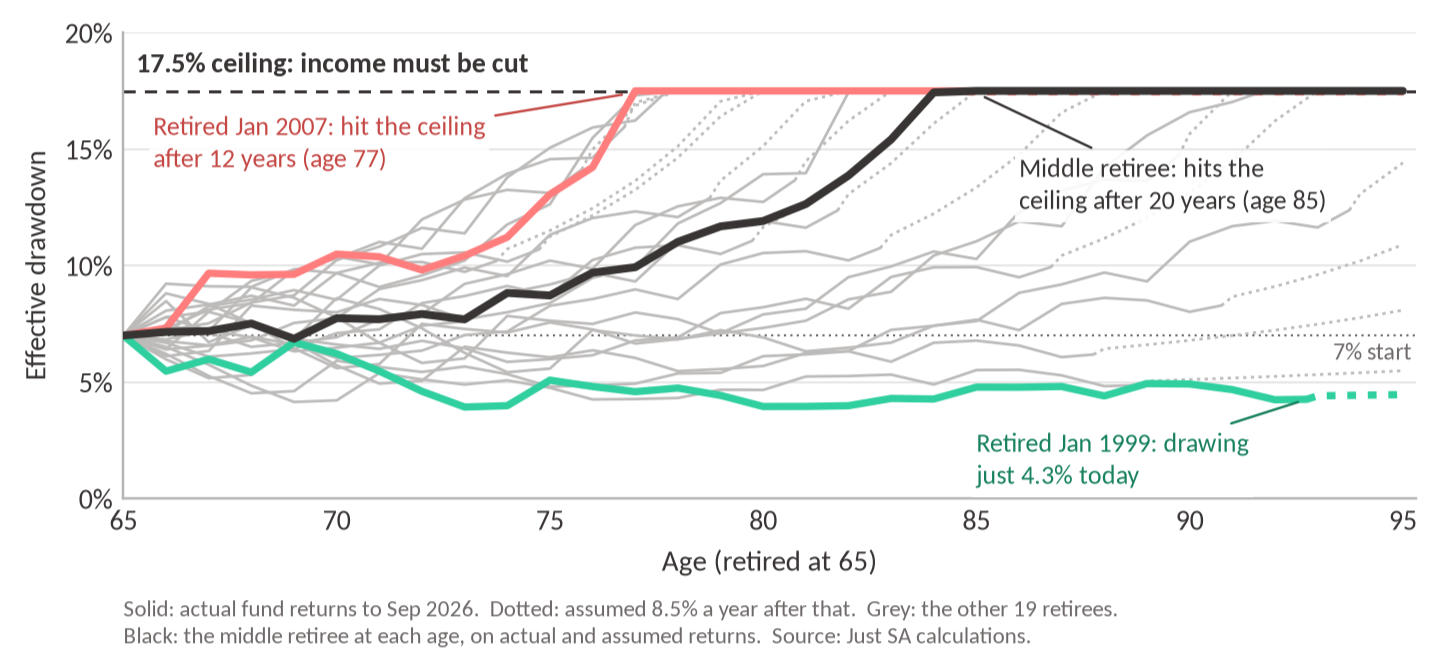
That's 16 out of 21 whose income is cut before 95. Even the average retiree hits the ceiling after about 20 years, at 85, and many of your clients will live well beyond that.
Same 7% start, very different retirements
Effective drawdown of 21 retirees, one for each year from 1998 to 2018. Each started on R1 million at 7%.
Bad timing, not bad decisions
Picture two neighbours who retire 12 months apart, with the same amount, the same fund and the same 7% drawdown. The January 1999 retiree hit the jackpot: they're drawing just 4.3% today and still have about R6.6 million. The January 2000 retiree hit the ceiling in September and faces an income cut from January 2027. Neither did anything wrong.
That's sequence risk. The lucky ones had strong returns early on, which built a buffer. The unlucky ones met weak returns and high inflation just as their withdrawals started. The January 2007 retiree got the global financial crisis (a 20.8% fall) plus inflation increases of 9% and 9.5%. The first five to ten years matter most, and nobody gets to choose their retirement year.
So, what is sustainable?
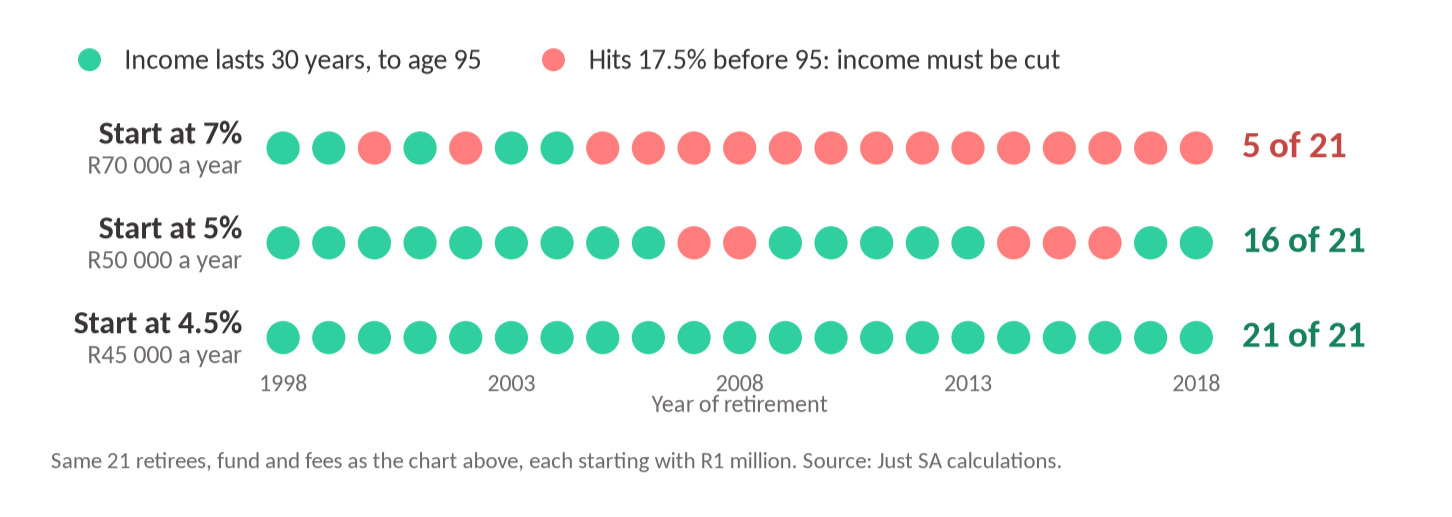
Start lower and the picture changes. At 5%, 16 of the 21 keep their income to 95. At 4.5%, all 21 do. A lower start leaves room to absorb a bad year or two.
The catch? 5% pays R50 000 a year, not R70 000. That's why so many clients choose 7%.
How many of the 21 retirees keep their income to age 95?
Need more income? Take the luck out
This is where a guaranteed life annuity earns its place. It pays an income for life, however long the client lives and whatever markets do, so longevity, investment and sequence risk move to the insurer. And it doesn't just manage risk, it pays more too. A client drawing on their own capital must plan for it to last to 95, but an insurer pools longevity risk across many lives and only has to price for average life expectancy. That pooling creates survival credits, so the income rate is higher than a sustainable drawdown. The increase option (CPI-linked, fixed or with-profit) handles inflation.
It doesn't have to be all or nothing. Blending usually follows one of two methods. Either buy enough guaranteed income to cover the client's essential expenses, or buy enough to bring the effective drawdown on the rest back to a sustainable level.
What to do at the next review
This year is a real test: returns have been modest, petrol is up about 50% since January and 2027 medical aid increases average around 8%. Expect drawdowns to jump, or real income cuts. So:
-
Work out each client's effective drawdown: income divided by capital at the review.
-
Show them the number, and how much room is left before 17.5%.
-
Running out of room? Blend in guaranteed income while there's still capital to do it.
None of this means a living annuity is wrong. But relying on one alone, at 7%, is relying on luck.
About the numbers
These figures are illustrations only, not forecasts. We've made every effort to avoid errors, but there may still be some. The core assumptions:
-
One retiree a year from 1998 to 2018, each retiring at 65 with R1 million.
-
Actual returns of a South African balanced fund to September 2026 ("today" in this note), after investment fees and a further 1% a year for advice and platform fees.
-
From October 2026, a steady 8.5% a year after all fees, with inflation of 4.5%.
-
Income rises with inflation every January until it hits the 17.5% legal maximum.
Past performance is no guide to future returns, and outcomes will differ. Sources: ASISA (3 September 2026), Stats SA, Department of Mineral and Petroleum Resources, Discovery Health and Just SA calculations.
Need more information?
To discuss this or get a quote, email sales@justsa.co.za or call 087 238 2690. Registered advisers can also use JustTools; if you're not registered, email info@justsa.co.za.
Disclaimer: This newsnote is for information only and is not advice as defined in the Financial Advisory and Intermediary Services Act 37 of 2002. Clients should seek advice from an authorised financial adviser. Just Retirement Life (South Africa) Limited is a registered life insurer, regulated by the Prudential Authority and the Financial Sector Conduct Authority, and an authorised financial services provider (FSP no. 46423).